Pressure-Canned Tuna in Olive Oil
Ingredients:
- MSC-certified skipjack tuna (pole-and-line caught)
- Olive oil (for packing)
- Canning salt (optional)
Method:
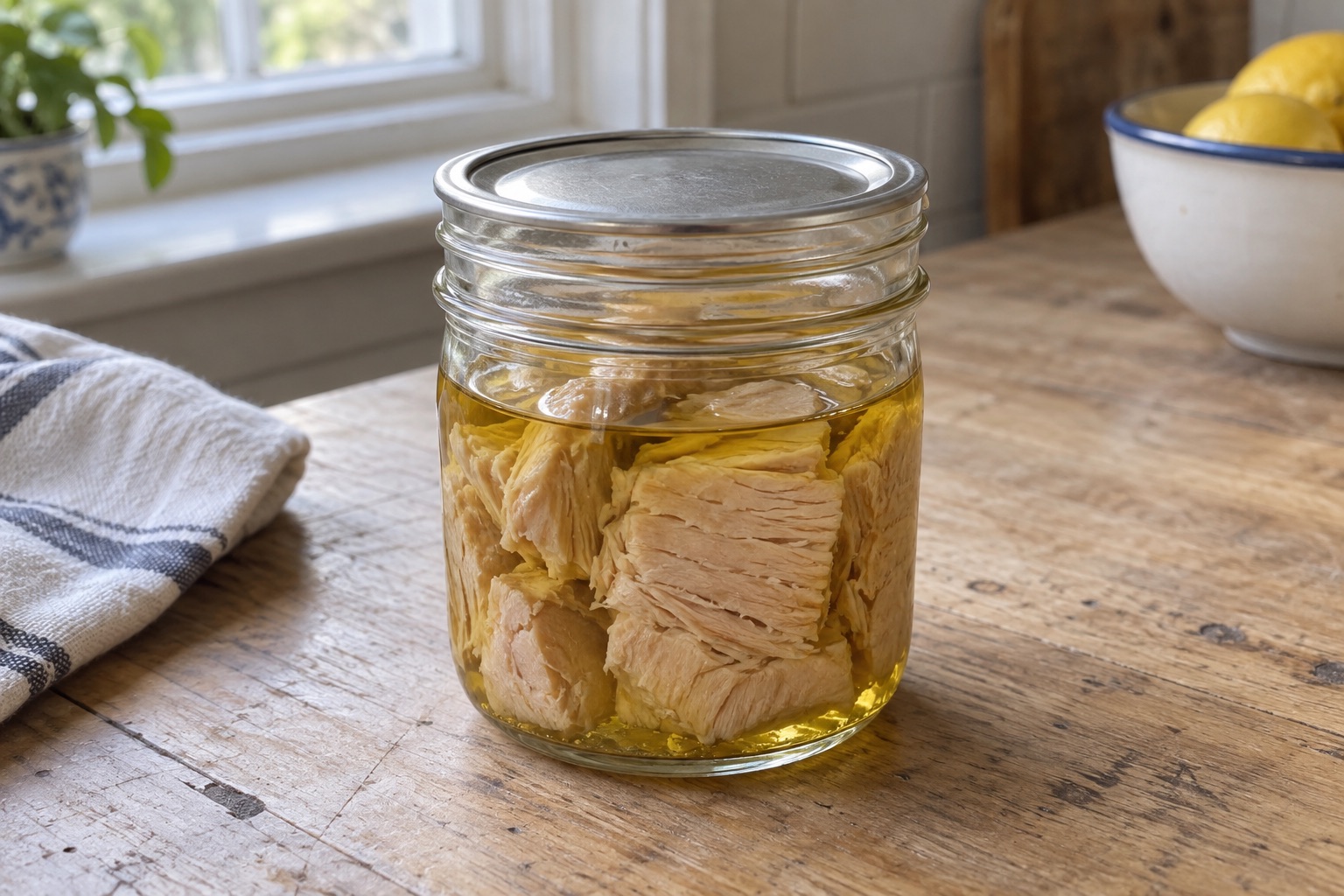
Tuna preserved in olive oil
Firm pieces of tuna packed in olive oil, ready for a simple lunch with bread or beans. The oil goes into the jar before pressure processing. This follows the precooked-tuna option in the USDA/NCHFP tuna method; use tuna, not sardines or mackerel. Plan for cooking, overnight refrigeration, canning and a further 12–24 hours of undisturbed cooling. Yield depends on the fish and jar load.
Equipment and preparation
Read the complete linked method and pressure-canner instructions before starting, alongside your equipment manual. Use a proper pressure canner large enough to hold at least four US quart jars upright; an ordinary pressure cooker, electric multicooker or boiling-water pan is not a substitute. Check a dial gauge for accuracy before the season and observe the manufacturer's minimum load and water requirements.
Use US half-pint or pint Mason-type canning jars, approximately 237 or 473 ml, with new flat canning lids and screw bands. Do not substitute 250/500 ml jars, larger jars or clip-top jam jars without a tested procedure for them. Inspect, wash and rinse jars; keep them hot. Prepare lids as their manufacturer directs. Jar guidance. For this recipe, choose fresh MSC-certified skipjack tuna (Katsuwonus pelamis), caught by pole and line. Ask your fishmonger to confirm the species, certified origin and catch method; the species name alone does not establish sustainability. Pole-and-line fishing is selective and has low bycatch, while MSC certification also assesses the fishery and its wider impacts. See MSC: choosing tuna and MSC: pole-and-line fishing. This sourcing choice keeps the tested tuna-in-oil procedure; it does not authorise substituting sardines or red mullet.
Cook, then chill overnight
Keep fresh tuna on ice. Remove the viscera, rinse well in cold water and drain the blood from the cavity. Place belly down on a rack in a roasting pan; cut crosswise if necessary to fit. Bake at 250°F (121°C) for 2½–4 hours according to size, using a clean thermometer to verify an internal temperature of 165–175°F (74–79°C), as specified for this precooking method.
Cool promptly in shallow portions and refrigerate at 4°C or colder within 2 hours, or 1 hour above 32°C ambient temperature. Chill overnight to firm the flesh. The next day remove skin, blood vessels, discoloured and dark flesh, all bones and fin bases. Divide the meat into quarters, then pieces that fit the jars.
Pack with olive oil and process immediately
Press tuna pieces gently into the jars to form a solid pack. Add olive oil to cover the tuna, leaving 1 inch (2.54 cm) between the contents and the jar rim. Release trapped air with a non-metallic bubble remover and recheck that headspace. Optional salt: ½ teaspoon per half-pint or 1 teaspoon per pint. Add no garlic, herbs or vegetables. Wipe oily rims thoroughly with a clean damp paper towel, then dry; fit lids and tighten bands as directed, not excessively. Do not refrigerate these filled jars to mature: pressure-process them now.
Pressure and timing
Use the canner rack and the water quantity specified for the long fish process; OSU seafood guidance specifies 4–5 inches of water. For this chilled pack, start with warm water no hotter than 140°F (60°C), following the canner instructions. Keep jars upright. Lock the canner lid and leave its steam vent open. Once steam flows continuously, vent for a full 10 minutes, then fit the regulator or close the vent as directed.
Process both half-pints and pints for 100 minutes at the pressure below. Start the 100-minute timer only when the required pressure is reached. These are gauge pressures in PSI, selected for your canner type and the altitude where you are canning.
Dial-gauge canner — altitude in feet (ft):
0–2 000 ft: 11 PSI
>2 000–4 000 ft: 12 PSI
>4 000–6 000 ft: 13 PSI
>6 000–8 000 ft: 14 PSI
Weighted-gauge canner — altitude in feet (ft):
0–1 000 ft: 10 PSI
>1 000 ft: 15 PSI
Use the source altitude bands without rounding down; 1 metre = 3.28084 ft. Above 8 000 ft, obtain an appropriate tested schedule rather than extrapolating this table.
Maintain the required pressure throughout. If it falls below the target, restore pressure and restart the full 100 minutes. Do not count warm-up, venting or cooling as processing time.
Cool and check the seals
Turn off the heat and let the canner depressurise naturally. Do not use cold water or release steam to hurry it. Once fully depressurised, remove the regulator or open the vent, wait 10 minutes, then open away from your face. Lift jars upright onto a towel, spaced apart. Leave untouched for 12–24 hours; do not retighten bands or press lids during cooling.
Remove bands and check that lids are firmly vacuum-sealed. Label the contents, date, pressure and process time. A sealed lid alone does not prove correct processing. If processing was uncertain or a jar is suspect, do not taste it or try to rescue it by reheating. Consult the seal and storage guidance; never treat an unsealed jar as a finished preserve.
Storage and serving
Properly processed, sealed jars can be stored in a cool, dark, dry place; aim to use within one year for quality. You may refrigerate the finished jars after the full cooling and seal check. There is no required two-day maturation. Olive oil may cloud or solidify when chilled; this is a physical change, not a safety test.
Before eating, follow the NCHFP safety checks. Cold serving is appropriate only when the exact processing conditions, accurate gauge and sound seal are certain and there is no leakage, spurting, mould or abnormal smell. Appearance and smell alone cannot prove safety. Discard suspect food without tasting.
After opening, date the jar, refrigerate at 4°C or colder and use within 3 days. Take a portion with a clean utensil and return the jar to the fridge immediately. Let only the plated portion lose its chill briefly; eat promptly and never return it to the jar. Keep total time out of refrigeration below 2 hours, or 1 hour above 32°C. Opening or adding oil does not restart the storage clock.
Additional sources
Checked 13 September 2026: FDA: handling and cooling, USDA: storage after opening, UC Davis: chilled olive oil.